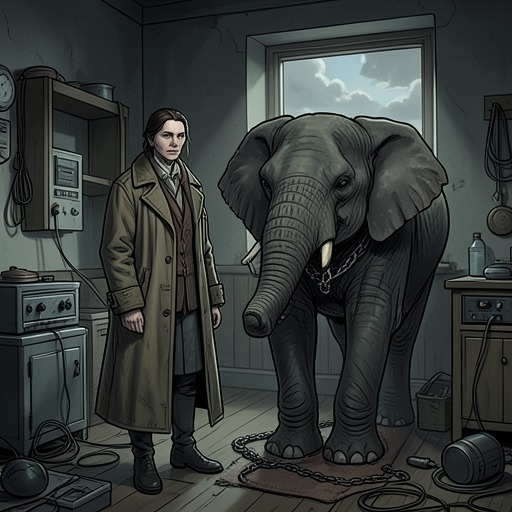
The magician sends the elephant home
The Magician's ElephantThe magician’s spell sends the elephant away from the people who have confined her, completing Peter Augustus Duchene’s hope that she might go home while exposing the limits of magical repair. In a snowy gathering, the magician speaks the original spell backward; the elephant disappears, and the snow begins again. Her destination remains a hope rather than something Peter can verify, but her departure changes the terms of the story: the magician has acted, the elephant is free of the scene, and Bettine LaVaughn chooses release over punishment.
Causes and Stakes
The elephant’s appearance had begun with a magician’s attempt to do something extraordinary. The accident at the Bliffendorf Opera House brought her crashing through its roof and left Bettine LaVaughn crippled. The chief of police, unable to find guidance in the law for a creature who had appeared from nowhere, faced pressure to treat the elephant as a criminal. Leo Matienne challenged that logic: the elephant had not chosen to fall through the roof, so, he argued, she could not fairly be blamed for the damage. Yet legal uncertainty did not protect her. She was eventually taken into the Countess Quintet’s possession, confined in the countess’s home, and treated as property.
The return spell therefore carries two linked stakes. The elephant must be released from a human arrangement that has turned her into a spectacle and possession; the magician must confront the harm caused by his own desire to perform an extraordinary act. The consequences cannot be reduced to whether he can make the elephant vanish. His attempt to undo the spell also requires him to acknowledge what cannot be restored.
The Attempt to Undo the Spell
By the time Peter and his companions bring the elephant to the imprisoned magician, Bartok Whynn laughs at the plan: they want to take her from there to the magician in prison so he can send her home. His laughter makes the request sound absurd, but the magician answers it seriously. When he learns that the elephant and Bettine LaVaughn are both present, he responds, “Merciful,” and says that he must try to undo what happened. Leo Matienne opens the cell, telling him that everyone is waiting.
Before casting, the magician explains the origin of the harm in his own words: “I intended lilies, but in the clutches of a desperate desire to do something extraordinary, I called down a greater magic and inadvertently caused you a profound harm.” He promises to try to undo it. Bettine asks whether she will walk again. He does not offer false reassurance: “I do not think so,” he says, asking her to forgive him. The exchange defines the spell’s moral stakes more sharply than its mechanics. The magician accepts responsibility, but admits that reversal has a limit.
Peter touches the elephant and says goodbye, thanking her for what she did. The magician circles her, thinking of the star he had seen from his prison cell, the snow that had finally begun to fall, and Bettine’s hopeful, questioning face. He speaks the words of the spell backward, and speaks the spell backward as well, under his breath. The narration stresses both his hope that it will work and his knowledge that only so much can be undone, even by magicians. The snow stops as he speaks.
Disappearance and Return
The others do not all witness the decisive instant. Peter alone keeps his eyes on the elephant and the magician, and the narration identifies him as the only person to see her leave. The change is abrupt: “The elephant was there, and then she was not.” With the spell’s reversal, the clouds return, the stars disappear, and snow begins falling again. The weather’s brief interruption frames the disappearance as an extraordinary event, while the four circular footprints left in the snow give Peter one tangible trace of the elephant’s presence.
Peter bends to look at those marks and says, “She is truly gone. I hope she is home.” His words preserve an important distinction: he can confirm her departure, but he cannot confirm where she has arrived. When he looks up, Adele is watching him, astonished. He tells her, “Home.” The word joins the elephant’s hoped-for destination to the reunion and recognition that now become possible for Peter and Adele; it is an expression of hope, not proof that Peter has seen the elephant reach her home.
Consequences and Significance
The spell accomplishes a release, not a complete restoration. The magician has sent the elephant away from captivity, but his answer to Bettine makes clear that her injury will remain. His apology does not erase the physical harm, and the narrative does not treat magical power as a guarantee that every consequence can be reversed. What changes instead is the response to that harm: after the elephant disappears, Bettine says that returning the magician to prison is pointless. She releases him, promises to press no charges, and offers to sign statements confirming her decision. Leo lets go of the magician’s arm, and the two exchange a bow.
That choice resolves the immediate conflict without pretending that nothing happened. Earlier, police and private ownership had determined the elephant’s fate, while Leo had insisted that causing harm and being morally guilty were not the same thing. At the end, the magician is no longer held solely within the logic of punishment: Bettine, the person he injured, decides to free him. The event’s final balance is therefore partial but consequential. The elephant is gone from the human world gathered around her; the magician has tried to repair what he caused; and Bettine chooses mercy while retaining the consequences of her injury. Peter’s hope that the elephant is home remains the emotional destination of the scene, even as the story leaves that arrival unwitnessed.